
Prompting series
Prompting Is Just Analytical Thinking (Here's How to Get Good at It)
Prompting isn't a dark art or a job title. It's analytical thinking applied. Here's what prompt engineering really is, and concrete ways to get better at it.

People talk about prompting like it’s a dark art. There are courses promising to turn you into a “prompt engineer,” threads of magic phrases to paste in, and a quiet worry that everyone else got a manual you missed.
They didn’t. Here’s the uncomfortable, freeing truth: prompting is mostly just thinking clearly about what you want, and saying it precisely. It’s analytical thinking, with a bit of imagination on top. That’s the whole skill, and yes, you already have most of it.
Let me make the case.
The myth: prompting as a secret profession
It’s easy to see why prompting got mystified. A good prompt and a lazy one can produce wildly different results from the same model, so it feels like there must be a trick, some incantation the pros know.
But look at what the people who actually build these models say. Anthropic’s own guidance treats prompt engineering as systematically structuring your input, through clarity, added context, and examples, to reliably get the output you want, rather than hunting for incantations.1 OpenAI’s advice rounds to the same thing: be clear, be specific, and give the model the context it needs instead of making it guess.2 No secret handshake. Just clarity.
In two years building AI systems as an engineer, I never once found a magic phrase. What I found was that the quality of my output tracked almost perfectly with the quality of my thinking before I typed.
What prompting actually is
Strip away the mystique and prompting is two ordinary skills working together:
- Analytical thinking: figuring out what you actually want, what matters, what “good” looks like, and what the model needs to know to get there.
- A bit of abstract thinking: holding a picture in your head that doesn’t exist yet, and translating it into words precisely enough that someone else could build it.
That second part is the one people underrate. Most bad prompts aren’t badly worded. They come from a picture that was fuzzy to begin with. If you don’t know exactly what you want, no amount of clever phrasing will save you, and the model will quietly fill the blanks with its own assumptions.
The assumptions problem (or: why AI feels “dumb”)
Here’s where things usually go sideways. AI needs detail, and when you don’t give it enough, it doesn’t stop to ask, it just assumes. Those assumptions come from the average of everything it has seen, which is very often not the specific thing in your head.
So you ask for “a marketing email,” picture your particular product and tone, and get back something generic. It feels like the model is stupid, but it isn’t: it answered the prompt you actually wrote, not the one you meant. The gap between those two is where almost all “AI is useless” frustration lives.
Close the gap and the model transforms. Both OpenAI and Anthropic make the same point: give the model the context it needs (who it’s for, the constraints, the format you want) instead of making it guess, and it applies that throughout.21 You’re not coaxing a reluctant genie. You’re removing its excuses to guess.
The Lego castle
The clearest way I’ve found to explain this: imagine asking someone to build you a Lego castle.
Say only “build me a castle,” and you’ll get a castle. Generically castle-shaped, technically correct, and almost certainly not the one you were picturing. Not because the builder is bad, but because you left every real decision to them.
Now say: “Build a castle with a moat, four round towers, a drawbridge over the moat, a flag on each gatehouse tower, and a hidden dungeon under the keep.” You’ll get something close to the image in your head, because you actually handed over the image.
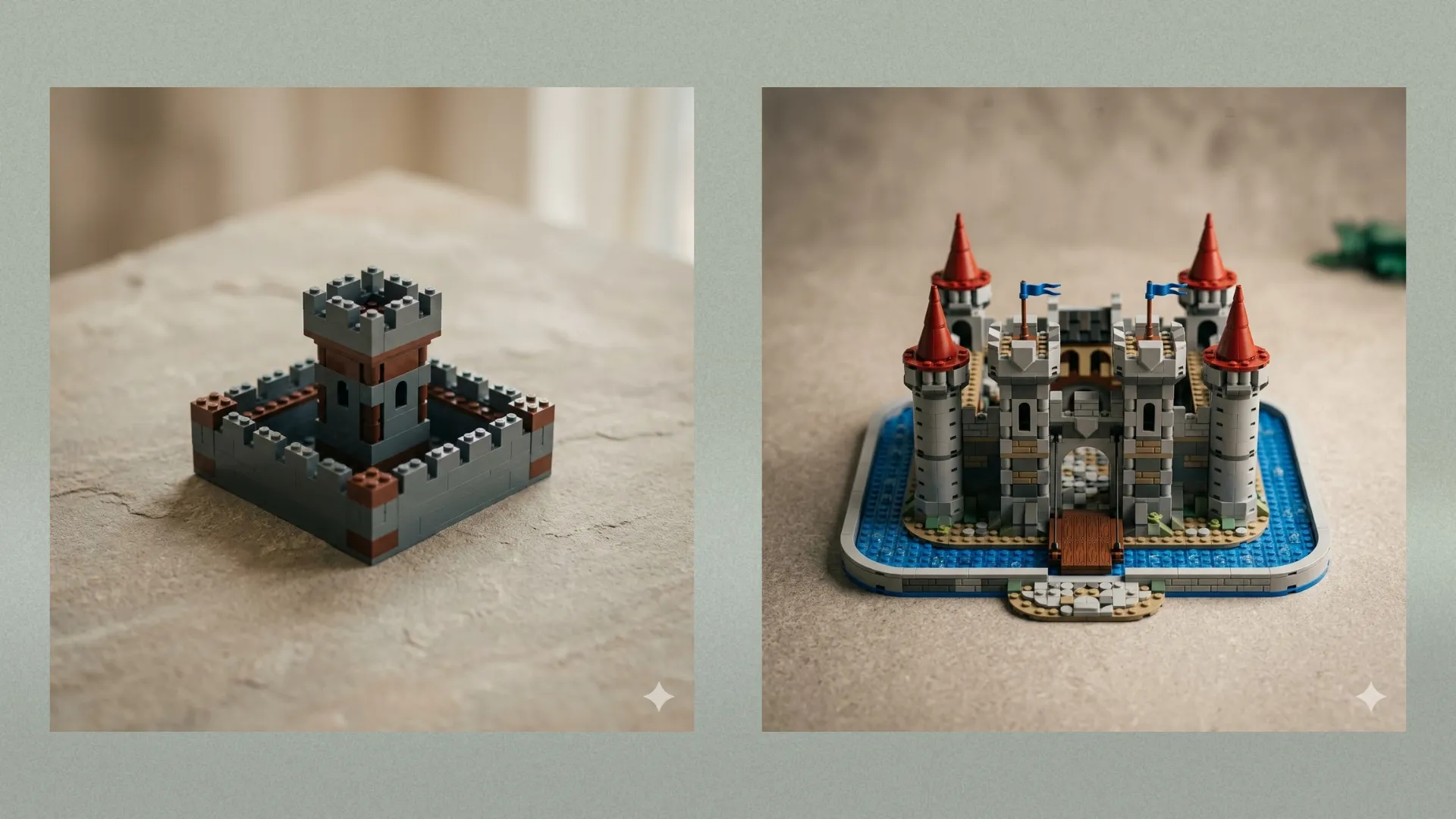
Same builder, same bricks. Left: “build me a castle.” Right: the specific version. The difference isn’t skill, it’s the spec.
That’s prompting. The model is the builder, your prompt is the spec, and the skill lives entirely in knowing what you want built and then describing it.
So the real skill is externalizing your own picture
Which means getting better at prompting is mostly getting better at two things you can practise deliberately:
- Knowing what you want. Before you type, answer for yourself: what’s the task, who’s it for, and what does “done” look like? If you can’t, that’s not a prompting problem but a thinking one, and it’s worth solving first.
- Saying it precisely. Name the task explicitly, give the relevant context up front, and specify the format you want. If you have an example of “good,” show it, since a single example does more than a paragraph of adjectives.1
None of that is technical. It’s the same discipline a good brief, a good ticket, or a good set of instructions to a new colleague has always required. Researchers studying this now frame prompting squarely as a critical-thinking and AI-literacy skill,3 which matches what I argued in What is AI literacy?: the durable skill is judgment, not tricks.
”But I don’t know what I want yet”
Sometimes you genuinely don’t have the picture. You know you want something (a plan, a name, a structure), but the details aren’t formed. That’s fine, and it’s not a failure of prompting. It just means the job changes: instead of handing over a finished spec, you use the AI to develop one with you, thinking out loud together until the picture sharpens.
That mode, prompting as a back-and-forth rather than a single perfect message, deserves its own post, and it’s the next one in this series. For now, the point stands: whether you arrive with the picture or build it in the conversation, the skill underneath is the same clear thinking.
Where this is heading
One honest caveat, because the field is moving. As the models get better at reading intent, casual prompting is getting easier. You need fewer tricks than you did two years ago. What’s becoming the real specialist skill is “context engineering”: deliberately managing everything the model sees, not just the prompt.4 We’ll get there later in this series. But that’s a refinement of the same idea, not a contradiction of it. The foundation is, and stays, clear thinking.
So no, you don’t need a certificate in prompt engineering. You need to know what you want and be able to say it. Get good at that, and you’re most of the way there. With AI, and with plenty else besides.
Frequently asked questions
Is prompt engineering a real skill?
Yes, but it’s mostly an applied thinking-and-communication skill, not a technical one. It’s the ability to work out precisely what you want and express it clearly enough that a model can deliver it. The model makers themselves describe it as a craft of clear, specific instruction and well-chosen examples, not a stash of special phrases.1
Do I need to learn coding to get good at prompting?
No. Prompting well is about analytical thinking and clear expression. You can become very good at it without writing any code.
Why does AI give me generic or wrong answers?
Usually because the prompt left out detail, so the model filled the gaps with its own assumptions. Give it the context, constraints, and format you have in mind, and the output gets far more tailored.2
What’s the fastest way to improve my prompts?
Before typing, decide what the task is, who it’s for, and what “done” looks like, then say exactly that, and show an example of good if you have one. Most prompt problems are really clarity problems.
Want to get genuinely good at working with AI?
This is exactly what we coach at Elevia: not prompt tricks, but the clear thinking that makes AI actually useful in your work, paced to what you actually do.
Sources & further reading
Footnotes
-
Anthropic, “Prompt engineering: best practices” (Claude docs). Frames prompting as systematically structuring input through clarity, added context, and examples to reliably get the output you want. https://platform.claude.com/docs/en/build-with-claude/prompt-engineering/claude-prompting-best-practices ↩ ↩2 ↩3 ↩4
-
OpenAI, “Prompt engineering” guide. Best practices on writing clear, specific instructions and giving the model the context it needs. https://developers.openai.com/api/docs/guides/prompt-engineering ↩ ↩2 ↩3
-
“A scoping literature review of prompt engineering for bridging students’ AI literacy in higher education” (Computers and Education: Artificial Intelligence, 2026). Frames prompt engineering as a critical-thinking and AI-literacy competency. https://www.sciencedirect.com/science/article/pii/S2666920X26000433 ↩
-
IBM, “Prompt engineering” guide (2026). On the field maturing and the shift from casual prompting toward context engineering. https://www.ibm.com/think/prompt-engineering ↩